Sunday, February 10, 2008

Bats

Residents of the inner-west are noticing blackened skies around dusk as a large camp of flying foxes leave their roost in the Wolli Valley and head out to feed in the suburbs.

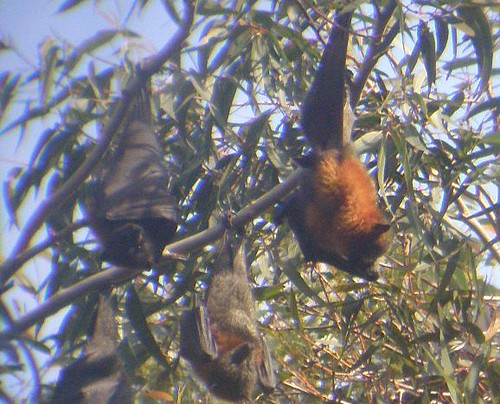
Many of these bats find their way to our school where they feast in the giant fig trees or find pollen in our Eucalypt trees. This bat was on a gum tree inside the ELA:


And this one in the giant fig trees at the front of the school:

The Wolli Valley camp was first established in the Valley in mid-2007 and then estimated to contain over 1000 Grey-headed Flying-foxes. A bat count in April 2008 estimated the population to be well over 5000 individuals. This dramatic increase in numbers means that many bats will become trapped or injured in areas where people are not used to them.

Bats entangled in fruit nets become badly injured by trying to escape. Do not try to remove the animal yourself (their bite may carry a disease called lyssavirus). Another problem for bats is electrocution on power lines but did you know that a young bat, clinging to its mother, can survive the electric shock? It helps to look at bats hanging from electric wires to see if a juvenile bat is attached and still moving! These youngsters will starve unless they are rescued.

If you find an animal that needs help call a wildlife rescue group such as Sydney Metropolitan Wildlife Services (02 9413 4300) or WIRES (1300 094 737).

Flying fox injuries include torn wings and damage to mouths as they try to fight their way out of fruit nets. Many of these injuries can mend with time, medical treatment and the devotion of wildlife carers. Bats can be released back to the wild where they can continue their important role as pollinators of native trees.

This is one of 5 bats recently from fruit nets and taken to a wildlife carer's home to recover.

--------------------------------------------------

In an attempt to address the growing curiosity of the community about these new residents, Marjorie Beck and Nancy Pallin of the Ku-ring-gai Bat Conservation Society will conduct a talk on bats at 7.30 pm on Wed 7 May in the upstairs meeting room. The talk will include a Powerpoint presentation about flying foxes and even a living example!

The KBCS is a non-profit community organization working for the conservation of all bat species, especially the Grey-headed flying-fox, and they are keen to share their knowledge with us. Their website is: http://www.sydneybats.org.au/cms/

Meanwhile, you can read more about flying fox habits on the WCPS website at http://www.wollicreek.org.au/flying_fox.html.

Bat facts

Bats are the only mammals that can fly.

The grey-headed flying fox is an endangered species.

Bats drink by dunking their bodies in water then licking the water off their fur.
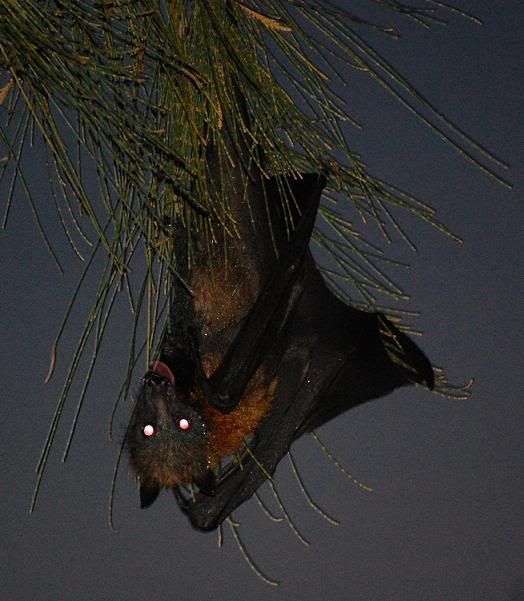

Grey headed flying foxes returning to roost in the Wolli Valley


Click here for video footage by Gavin Gatenby capturing the fly out on 22 November 2009. The temperatures exceeded 40 degrees and thousands of bats dipped into Wolli Creek to cool off and have a drink before heading out into the night.

Tuesday, November 27, 2007

Busy bees

Most people are familiar with the most common bee in Australia, the honey bee (Apis mellifera). What they might not know is that this species was introduced to Australia from Europe in about 1822 to ensure that the new colony had plenty of honey.


You might wonder why this happened if you knew that Australia has over 1500 species of native bees.

But most of Australia's native bees are solitary bees. They do not live in hives with groups of bees but individually create burrows to raise their young. With burrows scattered across all sorts of locations in the ground, in sandstone, in leaves, in hollow wood and even in the walls of houses it would be difficult to source their honey for human consumption.


Since the establishment of the Eco Learning Area, many different species of native bees have been observed at the school. Following are some examples from school. Follow the hyperlinks to external websites with more information and extra photos.

_____________________________________

Blue-banded bees

The Blue banded bee is a solitary bee. It is smaller than the honey bee and less aggressive. Even so, it can give a mild sting if touched or trodden on. These ones are pictured on tiny flowers in the herb spiral. The distinctive blue bands can be seen clearly in this image (photographed in the Wolli Valley).


_____________________________________

Trigona

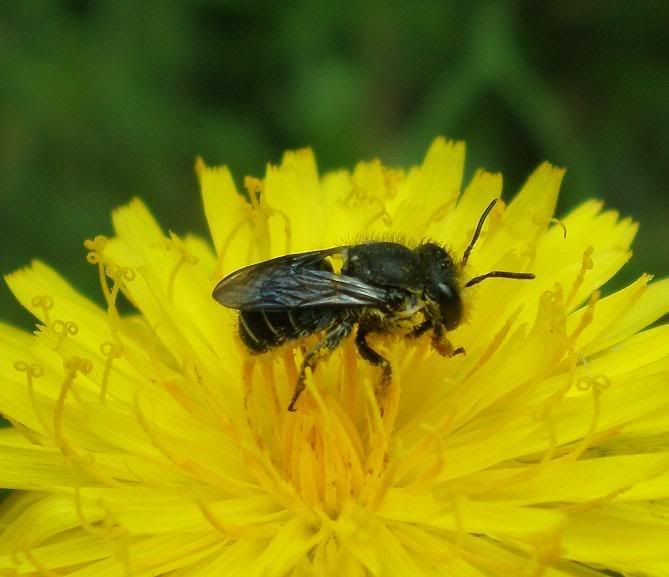
This next bee is one you probably haven't noticed... they are only about 4mm long! Trigona are one of the stingless bees. The images below show the size of Trigona in relation to a brocolli flower in the herb spiral and a dandelion in the Wolli Valley. Australia has 10 species of social bees which have the added bonus of being stingless! These are becoming increasingly popular as pets! You can buy a hive of native stingless bees for your garden. They are very important pollinators of native flowers. Some Australian plants are so unique they can only be pollinated by native bees.

_____________________________________

Red bees

The following bee, pictured on the tiny yellow flower of a brocolli plant could be Rayment's Red Bee (Lasioglossum hiltacum) but there are several similar bees in the Sydney region that also match.


Notice the pollen on its shoulders (click to enlarge image). Other bees accumulate pollen on their legs and abdomens (see below). And the colour of the pollen differs dramtically between flowers.


_____________________________________

Leafcutter bees

This next bee is thought to be the Gold-Tipped Leafcutter (Megachile chrysopyga). Leafcutter bees, as the name suggests, cut sections out of leaves to make nests for their young.


_____________________________________

Nomia bees

This drinking bee (below) is a Nomia, probably a Green and Gold Nomia (Lipotriches australica). Despite the very social look of the second photo these are solitary bees. A female bee will either build a nest, lay and care for her own eggs OR share a nest with other females but still care for her own eggs. While the females nest in the ground or in rotting wood, males simply cluster together at night. These males can often be seen in the warmer months gathered on a stem of lavender in the mint bed near the herb spiral.


_____________________________________

Cuckoo bees

The most spectacular bee so far observed in the ELA is the Neon Cuckoo Bee (
Thyreus nitidulus). A cuckoo bee does not bother with building its own nest but lays its eggs in another bee's nest. This bee has the most spectacular iridescent blue colour in flight. It doesn't land for long so keep your eye out for a bright blue blurr!


_____________________________________

Teddy bear bees

One last species seen in the ELA is the very cute but very elusive Teddy Bear Bee. This bee is also a solitary bee that nests in shallow burrows in the ground. The name comes from their fat, furry bodies. They have one distinct dark stripe across their russet-coloured abdomen.


For more information about native Australian bees, visit the following websites:

http://www.aussiebee.com.au and http://www.australiannativebees.com

Or visit this site to learn how to attract native bees to your garden and this site to find out what bees you can expect to find in your area.

Herons in the herbs

Recent rain has helped the herb spiral to flourish. It has also seen the rapid growth of the surrounding lawn and this has been the ideal habitat for some very elegant diners. A family of White-faced herons spent several days foraging for insects amongst the wet grass. When disturbed these enormous water birds would take refuge on nearby rooftops. But the herb spiral was too tempting and they were soon back for more.


The colouring suggests that the visitors are two juveniles - they are lacking the stark white face that gives them their name. Another difference is that juveniles fly with their neck extended while the adults curve their necks back into their bodies. These youngsters are lucky to have the school grounds to get used to the world before heading off for a life along the Cooks River and beyond. But we'll probably see them next year when they look for a safe place to nest.

Back in the school grounds another family of herons is just getting started. During the school holidays a nest was established in the same location as last year. For many weeks the only thing to be seen was the tail of the parent sitting on eggs and the increasing collection of white poo on the ground.

In recent weeks there has been much more activity. Three chicks have hatched and there is a flurry of activity every time a parent returns with food.


In a very short time the chicks have gone from fragile fluff balls with weak looking wings to quite sizeable and strong individuals. In between feeds they stretch their wings, walk (or rather stagger) around each other in the crowded nest or stand tall. This exercise will help prepare them for short visits to nearby branches and the ultimate challenge of learning to fly.

Thursday, November 8, 2007

Playground design

The May Fair successfully raised funds to improve the school grounds and upgrades were considered most needed in Playground C. In addition to this, the Environment Sub-committee (ESC) had negotiated for mass native planting to be donated by Transgrid under their Greengrid initiative.

With money and plants ready to go we nevertheless wanted to take our time to get it right. Year 3 undertook a design project that consulted students and came up with a comprehensive plan for playground improvement as part of the Kids’ Design Challenge in Term 3, 2007.

Here is the 3-D model of their proposal:


3W students questioned students in each class about their playground and activity preferences and, specifically, their likes and dislikes about Playground C. For 75% of Ferncourt students, this is their favourite playground.

3W’s Playground C Design Brief

The class developed the following design brief for improvements to Playground C which:

  • Allow maximum running areas
  • Protect and improve existing grass and trees
  • Make playing fields usable again
  • Make the playground safer and
  • Ensure the playground can be used and enjoyed by everyone from K-6.

Overall a majority of students approved all five suggestions. The most popular change was a second set of equipment and the least popular was the new Greengrid planting.


This close up shows the existing trees, interspersed with low-growing native plants around the perimeter. The soccer posts are re-oriented and the fence raised to prevent lost soccer balls!


There were also plans for a additional set of play equipment although it should be noted that Yr 3 were not working to a budget and the ESC had discovered through their research that even a small piece of play equipment would quickly exhaust available funds.


Sunday, October 14, 2007

The Rose Garden

The school's Rose Garden was established to complement the heritage building and, unlike other areas of the school, it focuses on a formal layout and non-indigenous species.


This garden reflects a time in history when gardeners aspired to replicating the English countryside rather than embracing the beauty and hardiness of Australian native plants.


In nearby garden beds, either side of the school entrance, there are Columbines, Flox and many other plants that might have graced these gardens in the building's past.


And lets just revist those delightful roses. These photos were taken in December 2007.