Thursday, September 24, 2009

Spuds - 2009

In 2009, the crop chosen for the Kindergarten bed was once again potatoes.

The ground was prepared in May and Kindergarten students took turns to plant their spuds.


This time three varieties were planted. They were: Sebago, Pontiac and Desiree.


One month after planting, the first leaves started to emerge.


Soon the garden bed was chock full of potatoey goodness!


In late September, as the holidays approached, the leaves began to brown and some potatoes could been seen poking out of the earth. It was time to harvest!


The kindergarten classes congregated in the ELA, anxiously awaiting their turn with a trowel.

There's something magical about digging in the ground and finding food.

The output from this crop was little more than we had planted! But not a bad haul considering there was almost no rainfall and very little watering undertaken.


The kids were very happy with what they'd gathered.

Read about the Harvest Day cookup in the School blog.
Click here for details of the 2007 potato crop.

Sunday, September 20, 2009

Trees

It's a sad day for the school as six mature trees have been removed to make way for the new school hall, including this beautiful old fig tree.

Click on image to enlarge.


Two of the trees were heritage-listed figs. They were planted by students in 1932 as part of an arbour day ceremony making them 77 years old. Four of these mature fig trees remain across the front of the school. It is hoped the foundations of the new building won't compromise their health.

An aerial photo of the school in 1943 shows eight fig trees. Some were subsequently removed because of disease and the danger of dropping branches.


Three other trees were removed included the Plane tree in the centre of B Playground and two Eucalypts.


It' s only a year since major work was undertaken to protect this Plane Tree from Sycamore Lace Bug.


Students survey the changes to their playground.


The school Principal has written the following:

Understandably there is a great deal of heartbreak amongst many of us to see trees being removed in order to place the hall on the site.
...
As part of the process the issues of the heritage building and the fig trees were included... the project managers, employed experts to do an assessment and make recommendations as to placing the hall to meet DET’s requirements and requirements for building next to a heritage site.

I have sought advice and my understanding is that this decision is not one that is negotiable as there is no other viable site and that the trees will be removed.

Concerns were also raised about the impact on the remaining figs which are across the front of the school. An aborist has advised the builders on the appropriate measures that must be taken to protect these trees during the building of the hall. They will be fenced off from the builders and strict guidelines are in place about run off from the site, dumping of materials in the vicinity of the trees and so on.

Sunday, August 30, 2009

Quick Survey


Click here
for the survey mentioned in the Enviro Newsletter.

Wednesday, June 24, 2009

Worms

In 2009, Year 1 established 2 worm farms on the balcony outside their classroom with the aims of reducing school waste and creating fertiliser for the gardens. Marrickville Council ran a workshop for parents and teachers on how to set up and maintain the worm farm and students provided fruit and vegetable scraps from their lunches to feed the worms.


Click here for a PDF file that tells you all you need to know about building a worm farm or fixing one that has gone a bit squiffy!

Some basic rules to follow include:


Other tips:

  • keep the worms damp but not too wet
  • avoid dryness as this encourages ants and cockroaches
  • in summer make sure the worm farm is kept in shade to avoid getting too hot
  • in winter, it will slow down a lot due to cold weather - unless it can be kept in a dappled shade spot to increase the heat and therefore the activity of the worms
  • use the right worm stock – red or tiger worms are recommended
  • use garden gloves to handle the worm farm to protect fingers from visiting spiders
Just in time for the May Fair, Year 1 bottled up the precious Worm Juice for sale.


They used recycled drink bottles that had come from the canteen and added stickers with information for the buyers:


The worm farms have been so successful that the school is now establishing a Worm Factory! There are to be 5 worm farms, one for each day of the week, and the aim is to use all the school's food scraps.

This week's Garden Club was very popular. Children who'd never been before came to get their gloves into gooey worms and squishy horse manure in the worm farm building process.


A week later, the Worm Factory was up and running thanks to the hard work (and busy colouring in) by Year One students.

Monday, April 6, 2009

Ride2school

0n 25 March 2009 the school participated in the Ride2school initiative and completed a HandsUp! survey to log the results.


The breakdown of who did what on the day can be seen in the results of the HandsUp! survey completed in each classroom by the teachers and collated by the P&C.


A pie chart showing the proportion of students that rode bikes or scooters, walked, caught public transport or came by private car is shown below:

Sunday, March 15, 2009

Wheat

There is a garden bed in the ELA reserved for Kindergarten to plant a crop and incorporate it into their learning for the year. In 2008 we planted a crop of wheat to tie in with a "Healthy Choices" subject. The idea was to demonstrate how long it takes wheat to grow, how much grain is produced, how much space is required for each loaf of bread that we eat. We learned some other lessons along the way!


The first challenge was to source some grain to grow and a parent with farm connections came to the rescue. Next was the big question of when to plant! and while there were a lot of different theories it was discovered that Australian wheat needs the cold of winter to germinate so on the 13th May the grains were planted in tidy rows.

Seven days later we had growth tips!

Click on the following thumbnails to see how the wheat looked after 7, 13, 42 and 85 days.


Just when we were counting on a bumper crop we had a visitor to our wheat field!


In fact many visitors arrived one afternoon to install a scarecrow. The intention was good: to protect the crop from harm. Birds will often eat grains before they have a chance to germinate and young shoots are often eaten by kangaroos, reducing the size of the harvest a farmer might get. Out ELA crop was unlikely to be threatened by kangaroos and seemed to have survived the birds too but it was not so lucky with the many enthusiastic feet that trampelled over it to install the scarecrow.
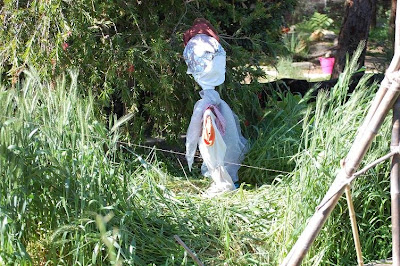

Farmers also risk having their crops flattened in the course of it's growth. If cattle get in to a crop from adjoining paddocks they can trample the wheat. Summer hail storms have been known to flatten and ruin crops just before they are ready for harvest which can be very disappointing for the farmer.

We were disappointed to see much of our crop flattened but the stalks that remained upright continued to ripen and by November we had lovely golden grains ready to pick.


The original plan was to process the grains to make flour and then use the flour to make bread with Kindergarten. While we were offered use of a mill that would turn grains into flour we have not yet devised a way to thresh our wheat heads and turn them into grains.

Stay tuned.


In March 2009, Year 4 learnt about where bread comes from and how it's made. They made pretzels in class as part of the lesson. Here is a drawing showing how bread is processed:
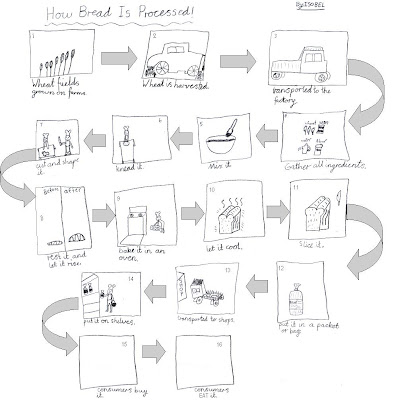


Activity: Draw the last two steps in the process.